
Summary
• Restaurant equipment breakdown claims costs doubled from 2024 to 2025, per Nation’s Restaurant News.
• Commercial property insurance premiums increased for six years, pressuring budgets and causing delays in maintenance.
• Equipment breakdown insurance excludes failure from neglect, deferred upkeep, or wear; insurers now strictly enforce these terms.
• Tight margins and rising costs have led many operators to insure their equipment below replacement value.
• Technician shortages are lengthening repairs, resulting in longer business interruptions and losses than policies cover.
Operators spent six years absorbing some of the highest commercial property insurance premium increases in two decades. Many responded rationally, deferring maintenance to stay solvent. Now, as premiums have finally begun to ease, they’re sitting on aging, undermaintained equipment, and the same insurers who were cashing their checks during the premium spike are scrutinizing claims more closely than ever.
The timing is not a coincidence. It’s a trap.
The Premium Surge That Sparked the Deferred Maintenance Crisis
To understand why 2026 is a tipping point, you have to go back to what happened in the market just before it.
Commercial property insurance went through 25 consecutive quarters of premium increases stretching from 2018 into early 2024, the longest hard-market streak in a generation.¹ The escalation accelerated sharply: Q1 2023 saw average commercial property rate hikes of 20.4%, the highest recorded in two decades.² By the second half of that year, increases were still running between 17% and 18%.
For food service operators already dealing with post-pandemic labor costs and volatile ingredient prices, these premium increases hit a line item that was already stretched. And when budgets get cut, maintenance is typically among the first casualties. It doesn’t produce revenue. The consequences of skipping it don’t show up immediately. It can seem, quarter after quarter, like the right call.
According to a survey of small business owners conducted by ERGO NEXT Insurance and cited in Nation’s Restaurant News, 21% of small business owners had no extra capital to invest in the second half of 2025.³ For restaurant operators specifically, that shortfall typically lands hardest on deferred maintenance and deferred equipment upgrades.
What Equipment Breakdown Insurance Actually Covers, and What It Doesn’t
This is where the misunderstanding becomes dangerous.
Most operators assume their business insurance covers equipment failures. What it actually covers is a more specific thing: sudden and accidental mechanical or electrical failures caused by internal events: power surges, motor burnout, electrical shorts. The language that excludes coverage is equally specific: failures resulting from neglect, improper maintenance, deferred upkeep, or normal wear and tear are not covered.⁴
Insurers have always had these exclusions. What’s changed is how aggressively they’re applying them.
Julie Roseland, Head of Commercial Liability and Property Claims at ERGO NEXT Insurance, wrote in Nation’s Restaurant News that her team is “seeing business interruption claims tied to equipment failures rising in both frequency and severity.” She noted that “insurers are scrutinizing claims more closely, often contesting whether damage was accidental (which is typically covered) or the result of deferred maintenance or wear and tear, which is not.” The average equipment breakdown claim cost, she reported, doubled between 2024 and 2025.³
The scrutiny makes financial sense from the insurer’s side. When claim severity doubles and volume rises simultaneously, carriers begin looking for ways to contest marginal cases. An operator with no maintenance records on a five-year-old refrigeration unit that catastrophically fails has given their insurer a very clean argument for denial. Without documentation of routine service, it becomes difficult to prove that the failure was sudden and accidental rather than the foreseeable result of neglect.
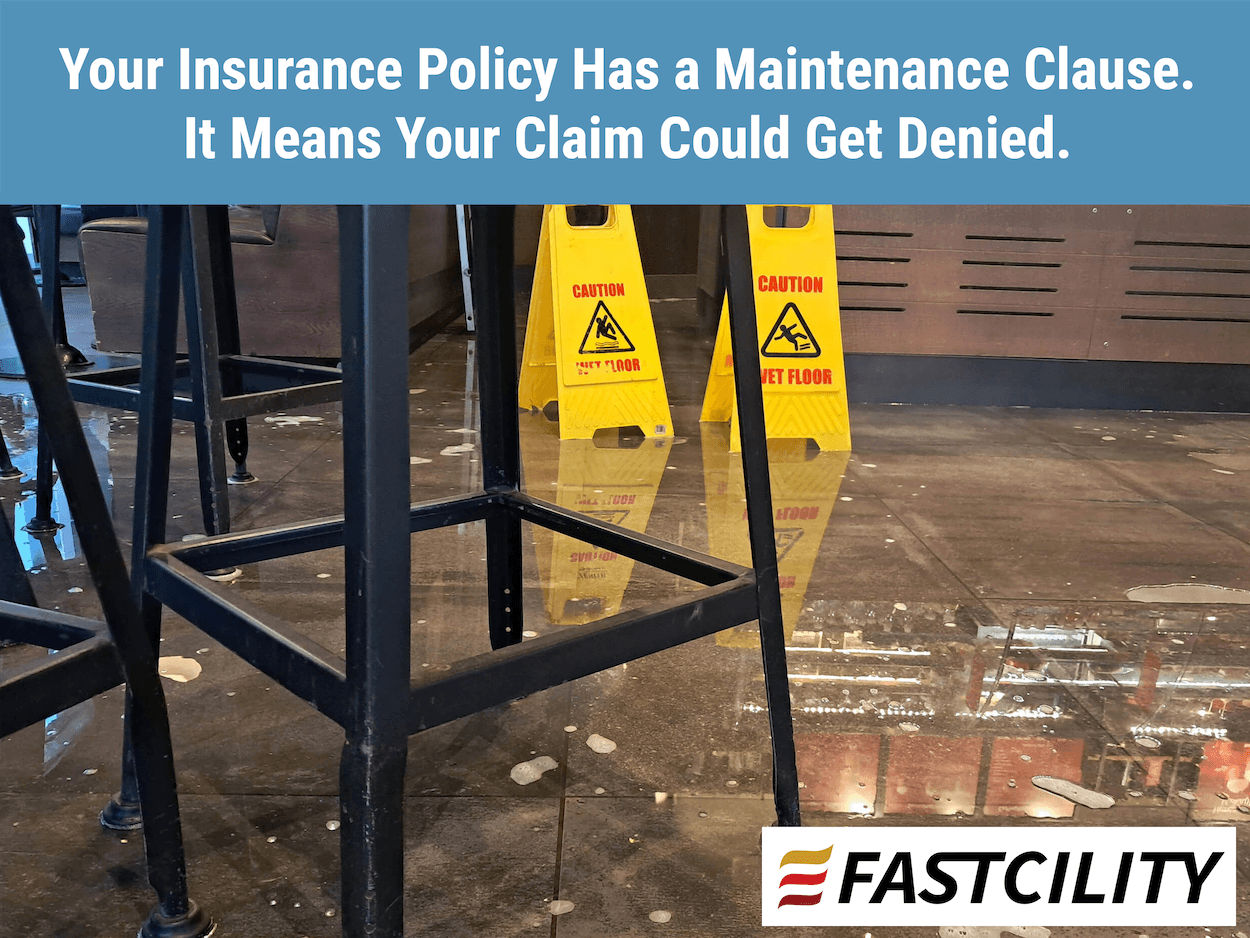
Most commercial property policies also include what insurers call a “Duty to Maintain” clause: a contractual requirement that policyholders take reasonable steps to keep covered property in serviceable condition.⁵ Adjusters look for evidence of compliance. Maintenance logs, service records, and PM visit histories are the documentation that answers that question. Operators who lack them aren’t just underprepared; they’re in breach of a policy term.
The Underinsurance Problem
Even for claims that aren’t denied outright, there’s a separate issue that’s growing quietly: many operators are insured for equipment at values that no longer reflect what it would cost to replace.
Travelers Insurance flagged this directly in its industry trend report. After years of rising material and labor costs, many businesses still carry equipment coverage based on valuations set several years ago.⁶ The practical consequence: if a walk-in refrigeration unit fails and needs full replacement, the payout may cover what it cost in 2019, not what it costs to replace today. The gap is the operator’s problem.
Producer Price Index data from the Bureau of Labor Statistics shows that building and equipment costs remain elevated even as consumer inflation has moderated.⁷ An operator who last reviewed equipment replacement values in 2022 could easily be 20–30% underinsured today.
The Technician Shortage Is Making All of This Worse
There’s one more structural factor that compounds the risk, and it comes from the labor market.
According to ManpowerGroup data cited by Travelers, 74% of employers currently report struggling to find the skilled technicians they need.⁶ Modern commercial kitchen equipment requires increasingly specialized service. The shortage means that when something fails, the wait for qualified repair is longer. Replacement parts for specific electrical components also remain constrained by ongoing supply chain issues.
Extended downtime is now a documented trend in equipment breakdown claims. Travelers specifically called out longer-than-expected shutdowns and costly interim equipment rentals as contributing to rising business income and extra expense claim costs.⁶ For operators who set their business interruption coverage limits years ago, that extended downtime creates a direct underinsurance gap; losses accumulate past the point where coverage applies.
The Moment This Becomes Actionable
Premium rates for standard commercial property have softened through 2025, with average increases settling around 3% after the brutal 2022–2023 period.⁸ For well-managed risks with clean documentation, brokers are finding more competitive pricing than any point in recent years.
This presents a specific opportunity: Operators with documented maintenance histories and updated equipment valuations can negotiate better renewal terms. Those without are increasingly seen as “challenged profiles,” facing stricter conditions even as the market relaxes.
The six-year premium increase led to deferred maintenance. Now, as the market softens, operators have a brief chance to resolve these issues before another major failure exposes gaps in coverage.
Footnotes
- Insurance Journal, “25 Straight Quarters of Premium Increases for Commercial Lines: CIAB Survey” (March 2024)
- CBIZ, “Navigating the 2024 Commercial Property Insurance Market”
- Nation’s Restaurant News, “5 Risks Restaurants Can’t Afford to Overlook in 2026,” Julie Roseland, ERGO NEXT Insurance (February 11, 2026)
- Pro Insurance Group, “Most Common Restaurant Equipment Breakdowns Covered By Insurance”
- Anderson & Associates Insurance, “How Deferred Maintenance Affects Your Insurance Coverage”
- Travelers Insurance, “Trends Shaping the Equipment Breakdown Insurance Marketplace”
- U.S. Bureau of Labor Statistics, Producer Price Index, December 2024
- Lawley Insurance, “2025 Midyear Market Outlook: Commercial Property Insurance”

Recent Comments